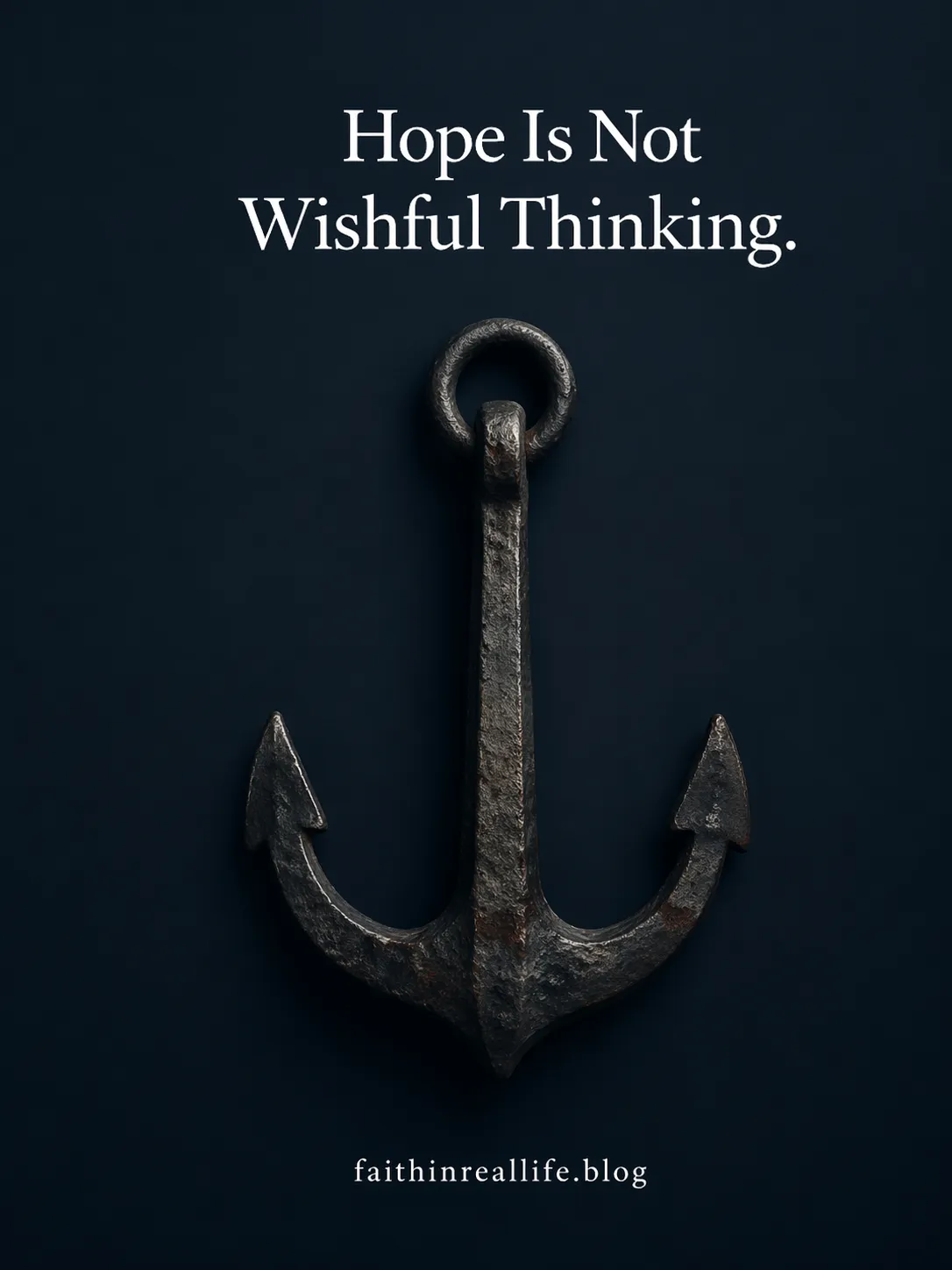
Hope Is Not Wishful Thinking
You've may have said it recently.
"I hope the treatment works."
"I hope the scan comes back clean."
"I hope things turn around."
It's the right word. It's the only word you have. But if you're honest — does it actually help?
Because what you're describing is a wish. A desire for a specific outcome that may or may not happen. The Oxford English Dictionary backs you up: hope is "a feeling of expectation and desire for a certain thing to happen."
A feeling. Uncertain by definition.
That's not nothing. But it's not stable either. And when the stakes are high enough — when you're waiting on a biopsy result, or you're three weeks into a treatment that's harder than you expected — you need something more than a feeling.
Here's what I've come to believe: most of us are running on the wrong kind of hope. And we don't even know there's another kind.
What an Anchor Actually Does
There's a line in Hebrews that I keep coming back to.
"We have this hope as an anchor for the soul, firm and secure." — Hebrews 6:19 (NIV)
Notice what it doesn't say.
It doesn't say hope makes the storm go away. It doesn't say hope guarantees the outcome you're praying for. It doesn't even say hope makes you feel better in the short term.
What it says is: anchor. Firm. Secure.
Do you know what a good anchor actually does? It doesn't change the water. It doesn't calm the waves. What it does is keep you from drifting — no matter how hard the current pulls. You're connected to something underneath the chaos. Something that doesn't move when everything else does.
That's a completely different thing than "I hope it doesn't rain tomorrow."
One is a wish. The other is a fixed point.
The Definition in English vs. the Biblical Version
Here's the contrast, laid out plainly.
The English definition of hope is emotion-based. It's about desire. It's future-oriented but uncertain — the outcome may or may not happen. It gives you temporary encouragement. At best.
The Biblical definition is different at its foundation. It's not grounded in what you want to happen. It's grounded in who God is — His character, His promises, His faithfulness. None of those change based on your circumstances. Which means the hope built on them doesn't either.
That's not optimism. It's not "positive thinking". It's confidence in something external to you — something that was there before your diagnosis and will be there after.
Paul describes it in Romans 5: suffering produces perseverance, perseverance produces character, and character produces hope. Read that sequence carefully. Hope comes out of going through hard things. Not around them. Through them. The hard thing is part of how the anchor gets set.
And Romans 8:25 says we wait for what we hope for — patiently.
Not desperately. Not frantically. Patiently.
That's a different posture entirely.
What I Learned in the Tunnel
In 2020, I was diagnosed with throat cancer. Metastasized to the lymph nodes.
I chose radiation treatment — thirty-four sessions inside a small, enclosed machine I started calling the "tunnel of doom." If you've never experienced a radiation chamber, it's exactly what it sounds like. Clinical. Tight. Designed to kill things. Well, cancerous things.
The first few times I slid in, anxiety was right there with me. Not dramatic panic — just the quiet, persistent kind. Is this going to hurt? Is it working? What if it isn't?
And I realized pretty quickly that if all I had was English-language hope — I hope this works, I hope I come out the other side — those thirty-four sessions were going to be a long exercise in held breath and crossed fingers.
But something else happened in that tunnel.
I had been reading the Bible seriously for about ten years by then. Daily. And the verses I'd stored quietly in my mind started showing up exactly when I needed them. When the claustrophobia crept in, a verse about fear. When I worried about pain that hadn't arrived yet, a reminder about living today and not tomorrow's fear.
At some point I stopped dreading the tunnel. I started looking forward to it — not the machine, but the conversation that happened inside it. Just me and God, thirty minutes, with nowhere else to be.
That's not the English version of hope. That's an anchor.
If you want the full story of how that shift happened, you can find it in my book, "The Desperate Bargain". It's at thedesperatebargain.com.
If You're In the Middle of It Right Now
I want to be direct here, because I think some of you reading this aren't doing so casually.
Maybe you just got news that changed everything. Maybe you're weeks into something hard and the end isn't visible yet. Maybe you've been praying for a specific outcome and you're starting to wonder if it matters.
A few things I'd want you to know.
Biblical hope is not denial. It doesn't require you to pretend the pain isn't real or the diagnosis isn't serious. It just refuses to let those things be the final word. This is hard and God is good. Both things are true at the same time. The anchor holds in the storm — it doesn't eliminate the storm.
You don't have to manufacture it. Romans 15:13 says God himself fills us with hope through the Holy Spirit. You don't have to feel hopeful before hope becomes real for you. You receive it. That's a very different posture than trying to talk yourself into optimism on the days when optimism feels dishonest.
It's not passive. Isaiah 40:31 says those who hope in the Lord will renew their strength. It's fuel. It's what keeps you showing up for one more treatment, one more conversation, one more day. It sustains endurance when endurance is all you have left.
Biblical hope says: this hurts, but God is good. I don't know what's next, but He does. I'm not alone, and I'm not without purpose.
That's not a feeling. That's a fixed point.
The Thing Most of Us Have Backwards
Here's what I've noticed — in my own life and in conversations with others going through hard things.
We tend to wait until we feel hopeful before we act like we have hope. We treat it like an emotion we have to access first, before we can do anything with it.
But that's the English version working on us.
The biblical version works the other way. You anchor yourself to what's true — about God's character, about His faithfulness, about the fact that He has not been surprised by anything that's happening to you — and the feeling eventually follows.
Not always immediately. Not always completely. But it follows.
The first step isn't feeling hopeful. The first step is admitting that you are not actually in control of this — and that someone else is, someone who can be trusted with it. That's not defeat. That's what makes the anchor possible.
It took me a long time to learn that. Longer than it should have.
One Question
Whatever you're carrying right now — whatever brought you to this post — I want to leave you with one honest question.
What kind of hope are you holding onto?
If it's the English kind — the "I hope this works out" kind — I understand. It's the only kind most of us were ever taught. But it won't hold in the storms that actually matter.
The other kind is available. It doesn't require a religious background or a theology degree. It doesn't require you to have it all figured out. It just requires being willing to let go of the illusion that you're the one holding everything together.
That anchor has held through my paralysis, through cancer, through thirty-two years of a very imperfect faith journey.
I think it'll hold for you too.
If this connected with you, I write about faith, doubt, and real life in this blog. Subscribe at the Faith In Real Life blog page. New posts a few times a month. No fluff.
