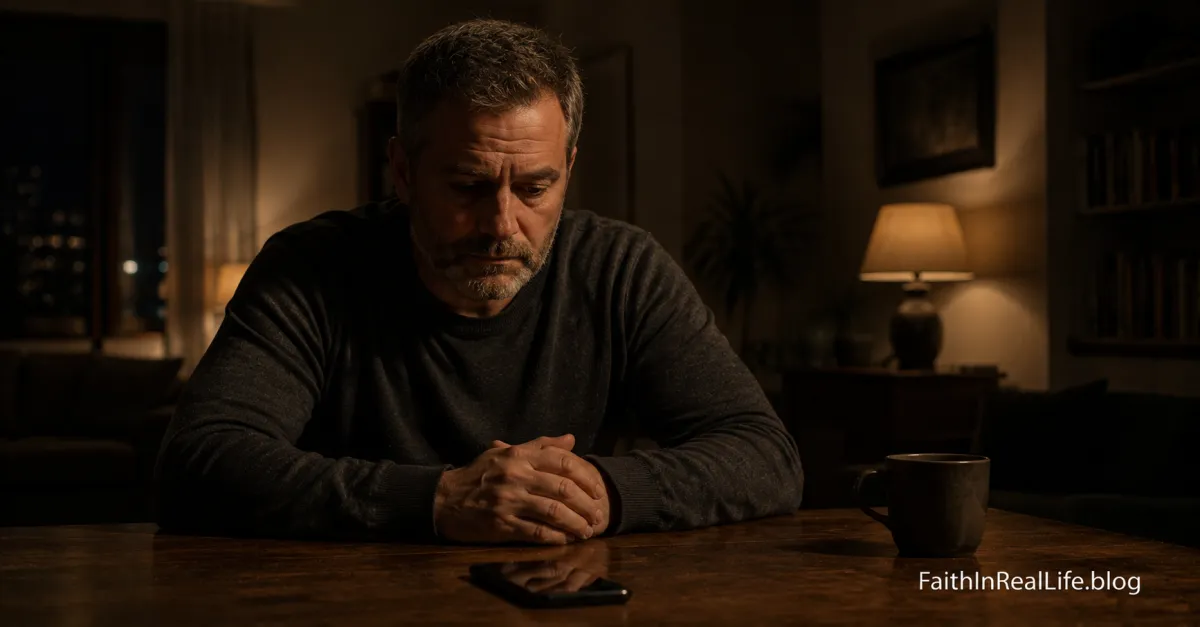
Why You Keep Staying Busy
There's a question I've been sitting with for a while.
When was the last time you sat in complete silence for thirty minutes?
No phone. No podcast. No task. No background noise. Just you, in a room, with whatever rises to the surface.
Most people can't remember. And when they imagine doing it now — something recoils.
Not because they don't have time. Because they're not sure they want to find out what's there.
A French mathematician named Blaise Pascal noticed this pattern in the 17th century. He was not a philosopher in the soft sense — he was an actual working mathematician. He built one of the first mechanical calculators. He developed probability theory. Precision was how he thought.
He also spent years preparing a defense of Christianity aimed at sophisticated, secular people who had decided religion was beneath them.
He never finished it. But a collection of his fragments survived — published after his death as the Pensées. And one of those fragments is a single sentence that explains more about the human condition than most books manage in three hundred pages:
"All the unhappiness of men arises from one single fact, that they cannot stay quietly in their own chamber."
Read it again slowly.
Pascal isn't talking about introversion. He's not prescribing more quiet time as a lifestyle tweak.
He's making a diagnostic observation: we cannot sit still because we are afraid of what we will find when we do.
Not external problems. Ourselves.
He had a name for the system we've built to avoid that.
Diversion.
Not distraction — that would imply an accidental looking away. But diversion is intentional. It's the deliberate choice to stay in motion rather than risk what stillness might surface.
And here's the part that's worth thinking about: most of our diversions are not bad things.
The career. The relationships. The fitness goals. The cause you're building toward. The community you're investing in.
None of it is wrong. Most of it is genuinely good.
But underneath the good work, Pascal says, is a systematic avoidance of stillness. Because stillness is where the question lives.
The question Who am I?
And as long as you're moving — as long as there's always a next thing — you don't have to answer it.
I recognize this in my own life more than I'd like to admit.
For a long time I kept the question at a manageable distance. New project. New credential. New version of the plan. The motion was real. The work was real. The results were sometimes real.
But the question was still there every time I stopped.
What Pascal helped me see is that the stopping wasn't the problem. The stopping was the point.
Because what rises to the surface in stillness isn't just emptiness. Underneath the emptiness is something else — a longing. Not just questions you don't know how to answer, but the awareness that there's someone you want to ask them to.
The restlessness, the hunger, the persistent sense that something's still missing even when things look fine — Pascal understood these not as defects but as signals. Built-in. Pointing somewhere specific.
But diversion keeps you from following them long enough to find out where they point.
Here's his challenge, made personal.
What would happen if you stopped?
Not forever. Just long enough to let the noise settle and see what's actually there.
Not to fix anything. Not to arrive at a conclusion. Just to sit with the question you've been outrunning — and let it be the question it actually is.
Pascal believed that what you'd discover in the silence is not what you've been afraid of.
It's what you've been looking for.
Think about the last time you filled a quiet moment — reached for the phone, turned on a podcast, started a task. What were you moving away from? What do you think was there?
The next post in this series looks at something Pascal didn't name — but Bunyan did. Something that sits even closer to home than busyness.
If this resonated, the free guide — "Why You're Still Stuck" — covers the structural reasons the identity search keeps stalling. It's short, honest, and won't preach at you. Get it here.
