Why Looking Inside Yourself Isn't Working
You've probably done the looking.
Not casually, but seriously. The journaling, the therapy, the long walks where you're really trying to think it through. The late nights when everyone else is asleep and you're just alone with your own thoughts, trying to figure out who you are underneath everything.
And you've found things. Real things. Patterns, fears, drives, contradictions. You're not unaware of yourself. If anything, you might be more self-aware than most people you know.
But the question is still open.
Not because you haven't looked hard enough. In fact, I think you've looked harder than most. But there's something about the looking that keeps not quite arriving. Like trying to see your own eyes without a mirror. You can feel them working. You just can't see them directly.
I think there's a structural reason for that. And a painting in a museum in New York helped me understand it.
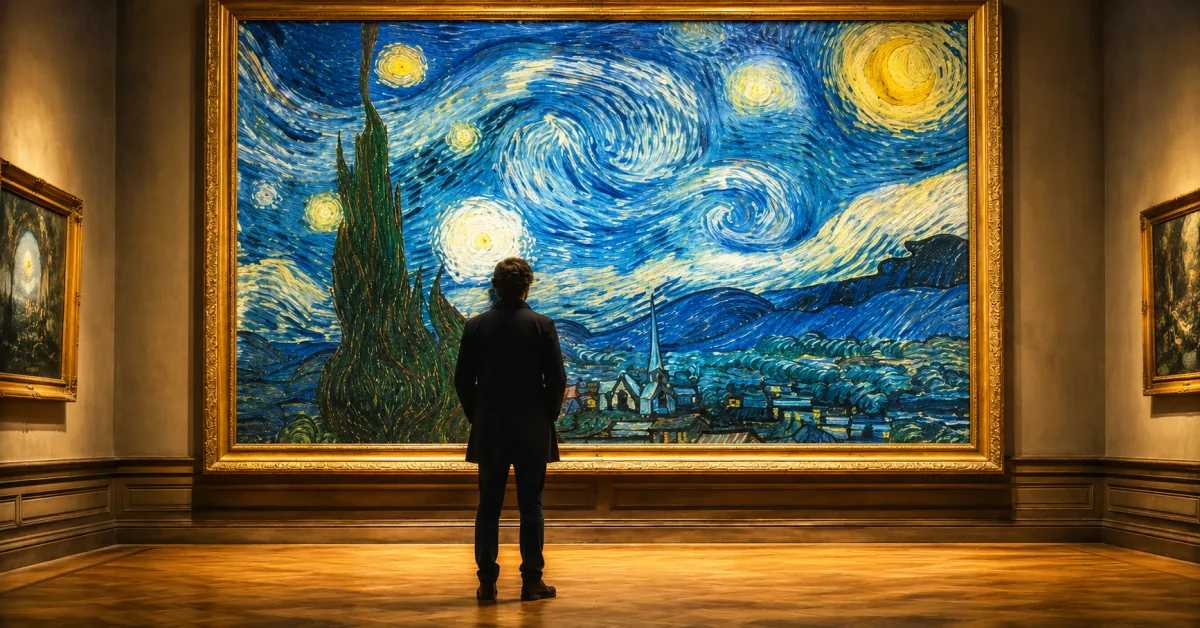
Van Gogh's The Starry Night hangs in the Museum of Modern Art. If you've seen it in person (really stood in front of it, not just scrolled past a reproduction), you know it does something that images can't capture. The paint is thick. Physical. You can see exactly where his brush went, the direction of each stroke, the pressure behind it.
And if you look long enough, something strange happens.
You stop seeing the painting and start seeing Van Gogh.
Not his face. But his way of seeing. His specific response to that particular night sky over Saint-Rémy. The swirling cypresses, the rolling stars. These aren't photographs. They're Van Gogh's interpretation. His unique vision, preserved in oil on canvas. No one else would have painted that scene that way. The painting is, in a precise sense, Van Gogh made visible.
Now ask a different question.
What does The Starry Night know about itself?
If the painting could think and study itself the way we study ourselves, what would it find?
Quite a lot. It could become very sophisticated about its own properties.
But there's one thing it could never discover by looking at itself.
Who painted it.
The evidence of Van Gogh is in every brushstroke. But the painting can't read that evidence from the inside. To know Van Gogh, it would need Van Gogh to tell it. The painter's identity doesn't live inside the painting in a way the painting can access. It comes from outside. From the painter himself.
Here's the thing I keep coming back to.
You are the painting.
Not as a poetic gesture. As a structural description of the problem.
If you were made, if there is a Maker behind the particular, unrepeatable combination of things that is you, then there is evidence of that Maker in you. In the way you think, the things you can't stop caring about, the specific shape of what you find beautiful or unbearable. All of it is brushstroke.
But you can't read all of it from the inside.
Not because you're not worth knowing. You're just on the wrong side of the canvas. You're the painting trying to see the painter by examining the paint. You can learn a lot that way. But the one thing you can't find, who made you and what they had in mind, can only come from outside.
This is why introspection keeps not quite arriving. It's not the wrong effort. It's the wrong direction.
Every framework, every personality test, every attempt to figure out who you are by looking more carefully at yourself: these are the painting studying its own brushstrokes. More sophisticated every year. More precise. And still, somehow, not the complete answer.
Because the complete answer isn't in there.
Van Gogh is dead. He can't tell The Starry Night who painted it, even if the painting could ask. That relationship is static, fixed at the moment of creation.
But what if your relationship with whoever made you isn't static?
What if your Painter is still painting?
I'm not going to tell you what I think that means in a blog post. That would be moving too fast, and you'd be right to call it out. But I'll leave you with the question that changed the direction of my own looking.
What if the thing you're searching for inside yourself can only be received from outside?
Not constructed. Not discovered through better introspection. Received, from the One who knows what He made when He made you.
That's a different kind of search than the one most of us have been running.
And it starts by looking in a different direction.
If the painting analogy hit something — I wrote a short guide that goes further into why this keeps happening to people who've looked as hard as you have. It's honest, it's short, and it doesn't ask you to commit to anything. Read it here →
