You Can't Prove It. Can You?
Someone pushed back on something I posted recently.
"You can't prove a god healed anyone ever."
Fair enough. I get it. And it made me think about a bigger question.
People want observable, repeatable, measurable evidence. Something that fits within the five senses.
That's the standard scientific framework — and it's not necessarily a bad one. After all, it's given us medicine, engineering, space travel. (And for me, a good part of my career 😀).
But here's where it gets interesting.
There's an old line in Hebrews that says that what is seen was not made out of what was visible.
And that idea might be closer to reality than many people think.
The Framework Has a Blind Spot
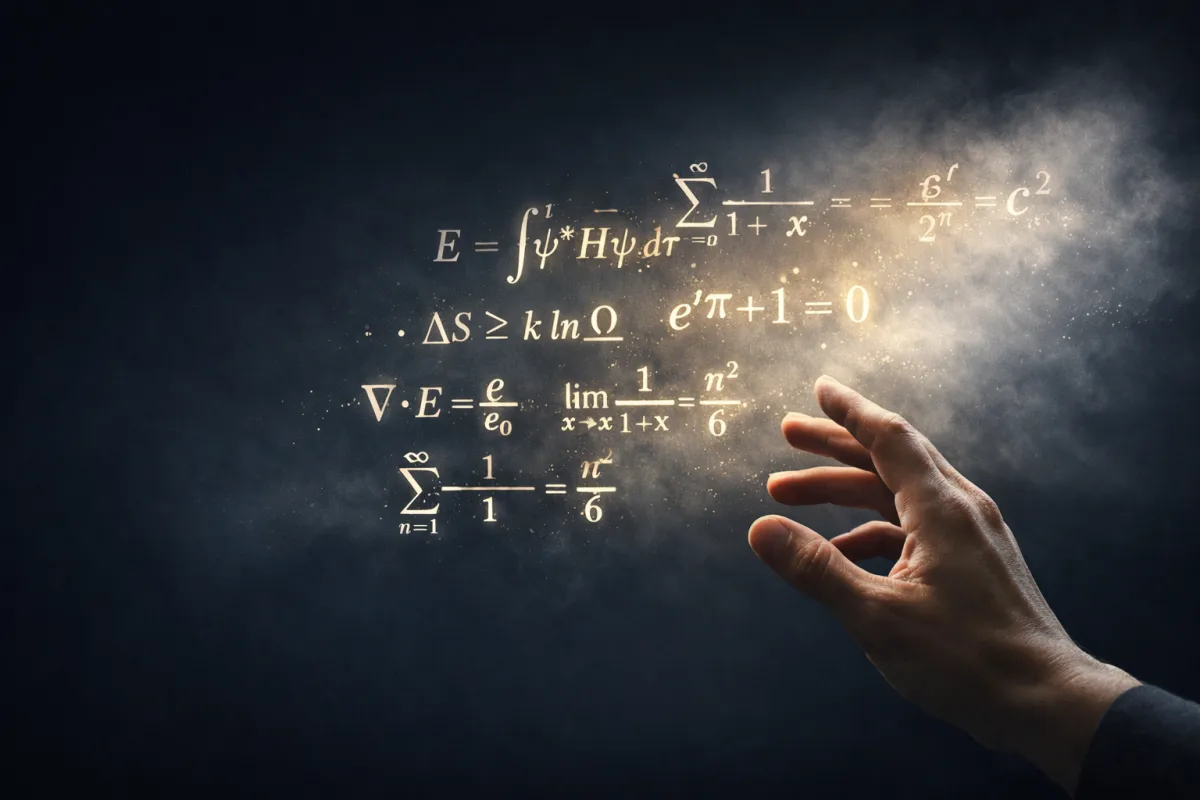
Science depends on mathematics.
You know this. Everyone knows this. There's no physics without math. No engineering. No measurement of anything.
But here's the question most people never ask:
Can you prove mathematics scientifically?
Can you observe a number? Touch an equation? Run an experiment on a theorem?
No. You can't.
Math is not established through the scientific method. It's known through reason. Through logic. Through mental structures that exist entirely outside the five senses.
And yet — science stands on it completely.
So here's the uncomfortable implication: the foundation of your most trusted knowledge system cannot be validated by that same system.
That's not an attack on science. That's just accurate. That's just "the way it is".
The Assumption Nobody Examines
Most people will say, "OK, but math is consistent. It works. Faith is subjective."
Right. And that may be a real distinction.
But math is also built on axioms — starting assumptions that cannot themselves be proven. You accept them because they're coherent. Because they lead somewhere. Because the whole structure holds together.
Logic has a similar role. It isn’t something we prove "from the outside" — it’s something we rely on in order to prove anything at all.
At the foundation of every system of knowledge — including the ones you trust completely — there is something you accept without proof.
That's not a weakness. That's just how knowledge works.
There's More Than One Way to Know Something
Think about it this way:
You don't use a microscope to solve an equation.
You don't use a ruler to measure a decision.
You don't use a thermometer to determine whether something matters.
Different questions require different instruments.
Science tells us what we can observe.
Math and logic tell us what we can reason.
History tells us what we can trust through testimony.
These are not competing. They're different categories. Each valid within its domain. Each limited outside of it.
The question isn't which one is real.
The question is: are you using the right tool for the question you're actually asking?
Back to the Original Claim
"You can't prove a god healed anyone ever."
If "prove" means: observable, repeatable, measurable through the senses — then no. You may not be able to prove it that way.
And I'm not going to pretend otherwise.
But that standard has limits we rarely examine. It can't validate its own foundation. It can't measure math. It can't explain why the universe behaves in ways that mathematics can describe at all.
Not every healing claim is legitimate. I'll grant you that. People misunderstand, exaggerate, misattribute. That's real.
But dismissing something entirely because it doesn't fit one particular framework — while that framework quietly depends on things it can't prove — that's worth thinking about.
The Verse That Keeps Coming Back to Me
Hebrews 11 opens with this:
> "Now faith is the assurance of what we hope for and the certainty of what we do not see. This is why the ancients were commended. By faith we understand that the universe was formed at God’s command, so that what is seen was not made out of what was visible." Hebrews 11:1-3 (BSB)
That's not anti-intellectual. It's not asking you to abandon reason.
It's saying: the visible world has an invisible foundation.
Just like science has a mathematical foundation it can't see.
Just like every system of knowledge rests on starting assumptions it can't fully prove.
Faith isn't a retreat from logic. It begins with the same kind of step — trusting what cannot be established through observation alone — but it extends beyond it.
One Question
We already believe in things you cannot touch, observe, or run an experiment on.
We believe in math. In logic. In meaning. In the idea that evidence matters.
None of those are grounded in the five senses alone.
So the real question isn't "Can you prove that God is doing this?"
It's this:
Are you open to the possibility that reality extends further than what any single instrument can measure?
Start there.
And you may find you're not stepping away from reality — but closer to what it's built on.
